A Look Back at the Symposium on the Exposome and Neurodegenerative Diseases Organized by Nexus TEDxPUM
On June 29 and 30, the Nexus TEDxPUM doctoral project organized the Symposium on the Exposome and Neurodegenerative Diseases. Over the course of two days, French and international researchers gathered to discuss the links between the exposome and neurodegenerative diseases, with a particular focus on Alzheimer’s disease.
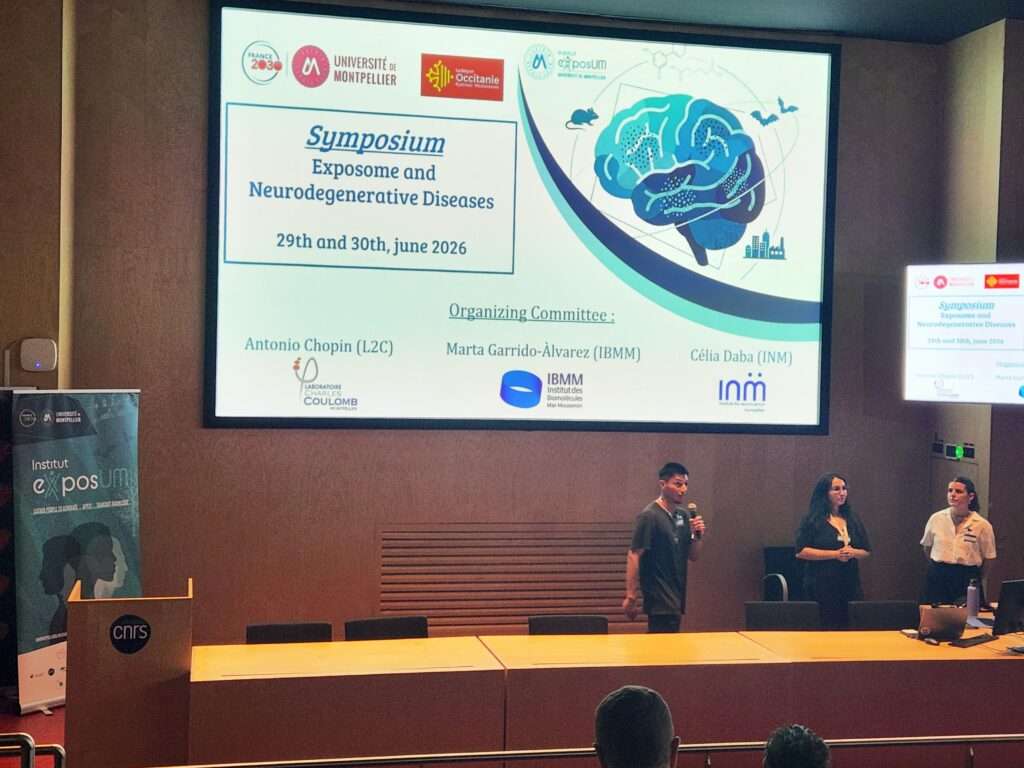
TheFirst Seminar of the Nexus Program
As part of the Nexus program, doctoral students are invited to organize a scientific seminar focused on their research topic. The doctoral students involved in the TEDxPUM project kicked off this initiative by organizing the first Nexus scientific symposium.
The symposium brought together several international experts working on neurodegenerative diseases and protein aggregation, including Fabrizio Chiti (University of Florence), Alexander K. Buell (Technical University of Denmark), and Salvador Ventura (IBB-UAB, Barcelona).
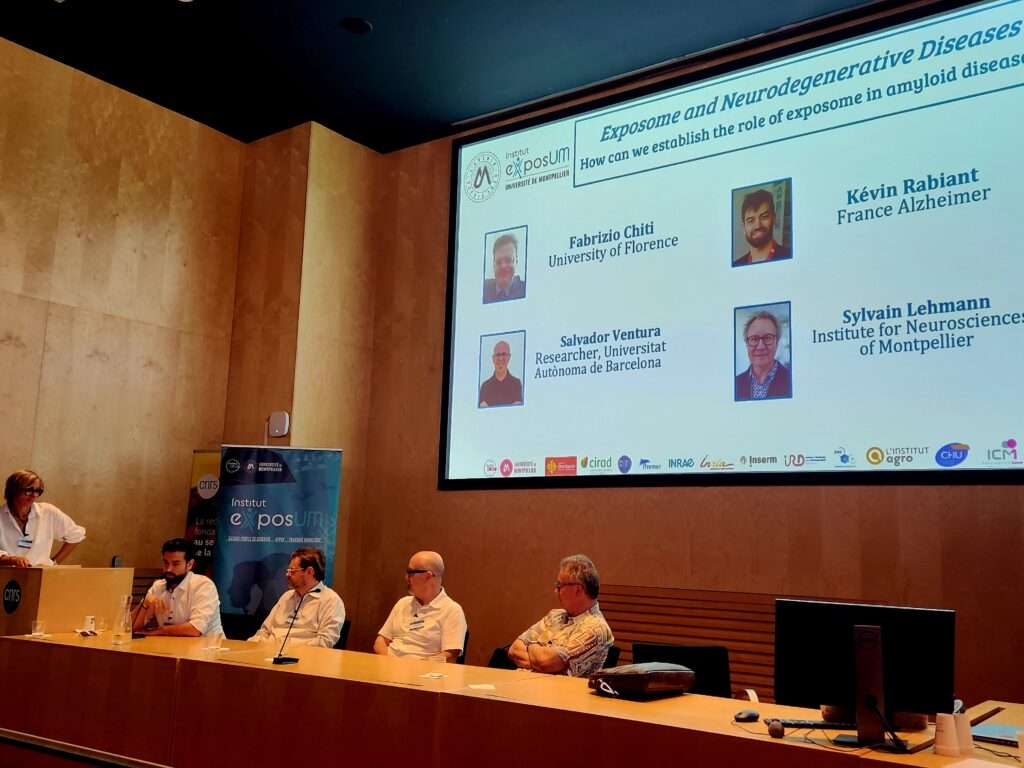
Roundtable discussion held during the symposium
Spotlight on the TEDxPUM Project
As a winner of the 2023 Nexus Call for Proposals, TEDxPUM is part of the first cohort of Nexus dissertations supported by ExposUM.
TEDxPUM focuses on the aggregation of the β-amyloid (Aβ) peptide in the brain, whose deposits are one of the main markers of Alzheimer's disease.
The research conducted as part of the three doctoral dissertations that make up the project aims to better understand how certain pollutants present in our environment—particularly pesticides, as well as nano- and microplastics—can promote the formation of these aggregates.
An interdisciplinary approach
Understanding the mechanisms by which β-amyloid peptides—which are approximately 0.6 nm in size—aggregate into clusters that can exceed one micrometer in size requires the use of techniques spanning several scientific disciplines. Consequently, TEDxPUM consists of three complementary doctoral dissertations in analytical chemistry, neuroscience, and physics.
- Marta GARRIDO ALVAREZ – IBMM (Analytical Chemistry)
The Impact of the Chemical Exposome on Beta-Amyloid Peptide Aggregation as Determined by Taylor Dispersion Analysis
Marta Garrido Alvarez is studying the aggregation process of the β-amyloid peptide in the presence of pollutants using Taylor dispersion analysis (TDA), an analytical technique that characterizes the size and proportion of molecular particles and tracks the aggregation of β-amyloid peptides.
This method is used here to evaluate the effect of pollutants on the aggregation process and the impact of each individual pollutant.
- Célia DABA – INM (Biochemistry/Biology)
The impact of environmental xenobiotics on amyloid-beta peptide aggregation and amyloid fibril polymorphism: relevance to Alzheimer’s disease
Initially, Célia Daba studies the effects of various chemical xenobiotics (polyphenols, pollutants, pesticides, etc.) on the aggregation kinetics of the β-amyloid 42 peptide and the structure of the resulting fibrils. The aggregates exhibiting the most significant changes are then evaluated in cell culture (neurotoxicity) and subsequently in vivo to analyze their pathological properties. - Antonio CHOPIN – I2S (Physics)
Impact of pollutants on beta-amyloid peptide aggregation: advanced analytical methods and modeling
Antonio Chopin is developing numerical analysis methods and analytical models to extract the physical information contained in measurements obtained by TDA and thereby track the formation of β-amyloid peptide aggregates. The goal is to better understand and predict the mechanisms of aggregation as a function of exposure to various pollutants.
By combining these approaches, TEDxPUM aims to shed new light on the interactions between environmental pollutants and the biological mechanisms involved in Alzheimer's disease.
This research also aims to establish a database documenting the effects of the various pollutants studied, in order to better understand their mechanisms of action and their potential impact on health.