Exposome Meetings: Health and Air Quality
Invisible, odorless, and yet omnipresent, air pollution is one of the most widespread forms of environmental exposure. Every day, an adult inhales an average of 10,000 liters of air. Unlike our food or water, we cannot choose to avoid exposure to it.
The first session of the Rencontres de l’Exposome was thus devoted to the links between health and air quality.
It provided an opportunity to bring together the perspectives of:
- Pascal Demoly, allergist and director of the ExposUM Institute
- Dominique Tilak, Director ofAtmo Occitanie, an Accredited Air Quality Monitoring Association
- Vincent Bittoun, a public health physician and doctoral student in the humanities and social sciences at the Nexus EZFE
- Olivier Cazorla, Researcher in Cardiac and Muscle Physiology and Experimental Medicine and thesis advisor at Nexus Pollheart
Air pollution—what are we talking about?
Several factors can affect air quality:
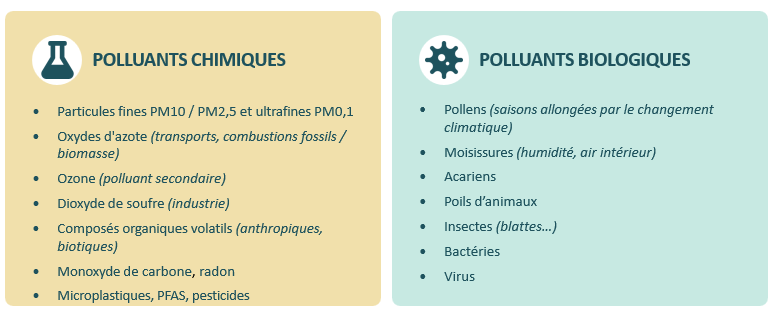
As for the health effects of these pollutants, some are already well established: asthma, chronic obstructive pulmonary disease, lung cancer, and cardiovascular disease.
According to Santé publique France, 40,000 premature deaths per year in France are believed to be linked to air pollution, particularly fine particulate matter (PM2.5).
ATMO Occitanie: The Air Quality Monitoring Center in Occitanie
Atmo Occitanie is an independent, state-approved nonprofit organization. Since 1996, it has been conducting air quality monitoring and providing information on air quality under the Act on Air Quality and the Rational Use of Energy (LAURE).
“Everyone has the right to breathe air that does not harm their health.” LAURE Act, December 30, 1996
The data show that air pollution remains a major public health issue in Occitanie. In fact, it is estimated that 32% of Occitanie’s population is exposed to air pollution, particularly fine particulate matter.
Learn more: “Assessment of Pesticides, Endocrine Disruptors, and PFAS in Occitanie: A First-of-Its-Kind Report”
To view air quality indicators for Occitanie, visit AtmoViz: an interactive data visualization platform developed by Atmo Occitanie.
The ExposUM Institute funds projects focusing on the links between health and air quality.
Doctoral Nexus Expo ZFE
Vincent Bittoun, a public health physician, is pursuing a doctoral dissertation in the humanities and social sciences as part of the Doctoral Nexus Expo ZFE program: “Analysis of a public health and environmental policy instrument, the ZFE-m, in the metropolitan areas of Toulouse and Montpellier.”
Doctoral NExus Pollheart
Olivier Cazorla, a researcher in physiology and experimental medicine—specifically, heart and muscle
—at the CNRS, is supervising one of the theses in the Nexus PollHeart doctoral program.
The PollHeart Project isled by three doctoral students in chemistry, biology, and mathematics.
The project focuses in particular on the transport and deposition of microplastics in the respiratory tract, on what is eliminated or remains in the lungs, and on the immune system’s response. Researchers are also investigating whether certain respiratory conditions, such as COPD, can alter the way microplastics are trapped in the lungs and whether they could act as an aggravating factor.
Finally, the project explores the development of membranes capable of capturing microplastics present in the air—both indoors and outdoors—in order to better analyze and quantify them.
Explore all the “health and air quality” projects funded by the ExposUM Institute.