Mobi’tiques: Using Sociology to Strengthen Citizen Engagement on Tick-Borne Risks in Occitanie
Launched by GRAINE Occitanie, funded by the ExposUM Institute (regional projects—2023 cycle), and supported by the University of Montpellier and the Occitanie Region, the Mobi’tiques project aims to develop and implement outreach initiatives designed to increase citizen engagement regarding tick-related risks in their local communities.
Ticks are vectors of pathogens that can cause various diseases in humans, such as Lyme disease and Mediterranean spotted fever. People who engage in outdoor activities (hiking, gardening, hunting, mountain biking, horseback riding, etc.) are particularly at risk. Raising awareness and promoting best practices can help reduce their vulnerability to ticks and the diseases they transmit.
“How can we develop a methodology for engaging the public on the public health issue of ticks, with the goal of promoting nature-based practices and reducing public health problems?”
That’s the question the Mobi’tiques project is asking!
To answer it, twelve educational facilitators from environmental education organizations in the GRAINE Occitanie network worked with groups of nature enthusiasts to encourage them to adopt and share best practices for preventing and managing tick bites.
The project aimed to conduct three sessions with each of the groups receiving support, not only to share knowledge but, above all, to foster a collective dynamic that would lead to the joint development of a concrete action.
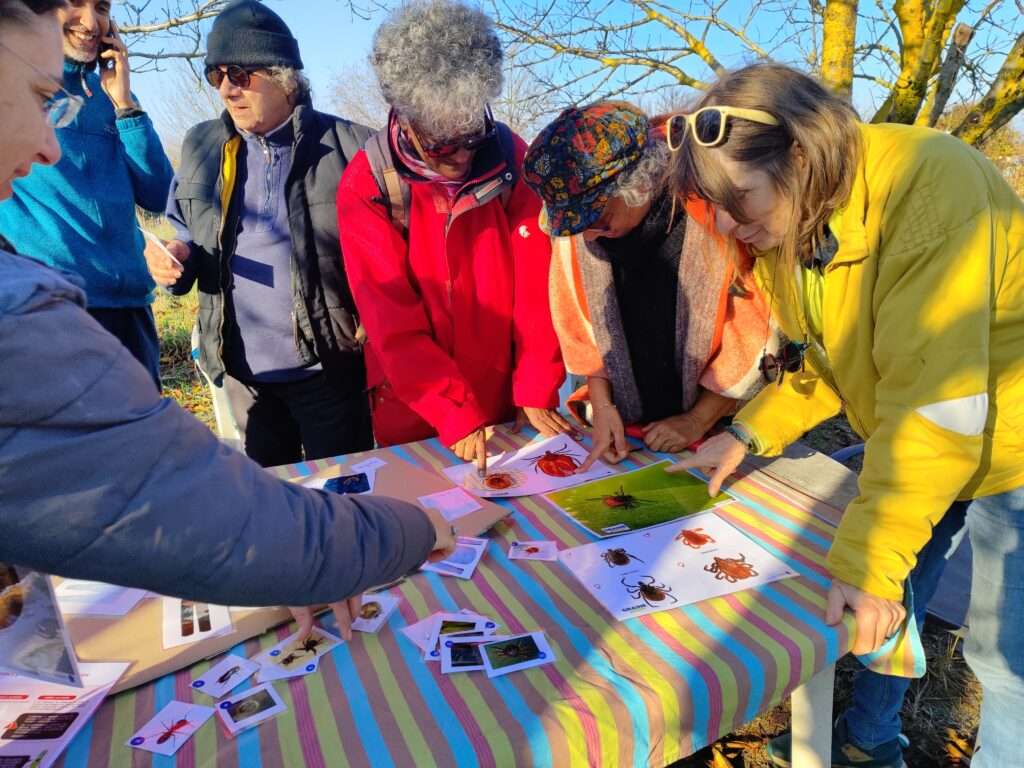
The Mobi’tiques research project analyzed the conditions that foster this civic engagement. Several key findings have emerged:
- Organizing sessions specifically dedicated to the project seems more effective than taking advantage of a group meeting to present the project.
- Providing knowledge alone is not enough to generate momentum for group mobilization. It is therefore best to begin discussing collective action as soon as possible.
- Using the issues, experiences, and challenges faced by the participants as the starting point for the process helps strengthen the group's engagement.
In summary, a top-down approach focused solely on the transfer of knowledge is not sufficient to foster collective mobilization. It seems more appropriate to build on the questions and challenges faced by participants and then draw on knowledge as collective actions are implemented.
The Next Steps in the Project
The investigations conducted as part of Mobi’tiques are now continuing under the Pik’Tro initiative, which aims to reduce the exposure of residents of Occitanie to four vector-borne and stinging hazards: ticks, tiger mosquitoes, and processionary caterpillars.